Monthly Report - November 2026 - India Visit
A report with a little difference this month, reflecting on my week spent in India visiting the port and markets around Kandla.
The NZ commercial forestry sector has a strong interest in this emerging market. Whilst we have been selling Radiata pine logs there for many years, the difference now is the recently signed Free Trade Agreement and a rapidly growing demand for our softwood logs which coincides with eye watering growth in the India economy.
My fact-finding mission focussed on identifying the challenges ahead for NZ forest grower to realise the full potential bought about by the FTA. This is a complex market and supply chain facing many challenges, some of which are not easily resolved.
Firstly, a quick recap on India v NZ:
India New Zealand
Population 1.48bil 5.3mil
Median age 29.2 38
Urban population 36% 84%
People per km2 497 20
GDP 6.65% 1.7%
India’s population is the highest on the planet by some margin and has one of the youngest median ages of any country.
These figures alone highlight massive opportunities for NZ to grow business by an immeasurable degree whilst hardly making the flag flutter in India.
Of most significance to a NZ Forest Grower is the 400 million middle income earners. This sector of the population spends big on growing wealth, buying houses and assets, many of which use wood. My litmus test of this potential included a quick review of the discretionary spend of your average middle class India citizen compared to a Kiwi. Hey presto, the available cash after paying the mortgage are both about the same at 63 – 65%.
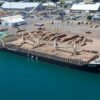
All logs from NZ in break bulk currently go to Kandla, the largest Port in India at about 160 million tonnes of cargo in and out per annum. Within 2 years this is expected to exceed 200 mil tonnes. This compares with Lyttleton and Timaru ports combined at 10 – 11 million tonnes annually.
Kandla is a major distribution facility with imported cargos including fuel (mostly crude), rice, fertilizers, logs, minerals, Iron ore and coal. Exported products include Salt, fertilisers, minerals, sugar, wind turbines and many others.
One of the challenges is logs can be discharged across a possible 8 berths for break bulk vessels, but only one is a dedicated log discharge berth, the rest are first in first served basis. Logs are taken directly off vessels to sawmill customers who have to wait in truck queues to uplift their logs. Discharge rates are generally low and dramatically need to improve.
Shipping congestion is also a major problem with consistently about 40 large vessels waiting at anchor to discharge or uplift cargo. Ships waiting charge charterers wait time called demurrage. The combined estimated cost to charterers at present is north of USD1.0mil per day. This then filters into the supply chain as a total cost against the products and commodities.
I met with the Chairman of the Port Company, a very high-ranking official who carries much influence. I was heartened to learn of expansion plans including a new 6 – 7km long berth targeting break bulk vessels. A range of more immediate fixit solutions were also presented which again was heartening. We are working to bring some to fruition.
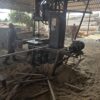
Visiting sawmills was certainly a step back in time compared to NZ. Working conditions would very much challenge Worksafe NZ inspectors, indeed likely send them into a tail spin!
There are about 2,500 softwood sawmills around Kandla. A sawmill comprises 2 band saws. The breakdown saw is horizontal and the breast bench vertical. The spinning bandsaws, devoid of any sort of guarding, are the only mechanical appliances, everything else is done manually.
There are on average 6–7 people operating each mill including shovelling the sawdust into fadges for on-sale to many and varied end uses. By a NZ standard, the systems are rudimentary. But they work, employ thousands of people and do so at a low cost. One could not help but be impressed by the simplicity and hard work in often terribly hot conditions.
Radiata pine is very much favoured by sawmill owners the best quality lumber sold into hugely varied markets. Construction, plywood, cable drums and packaging are the largest markets. Others include furniture componentry, mouldings, panels and block board.
Watch out for part 2 in my next report!
As always, please remember the thoroughly important message: ‘It remains fundamentally important, the only way forward for climate, country and the planet, is to get out there and plant more trees”!
Allan Laurie, MNZIF
Laurie Forestry Ltd