Monthly Report - May 2026
May has been better than expected for export logs with prices remaining stable. Key indicators are suggesting some head winds ahead but that nasty word “downturn” is not currently in the mix.
I noted my April report differed from other commentators on a key element which is the China Eastern Seaboard inventory. My reports reflect the Softwood Log inventory, the majority of which is NZ Radiata pine. This refers to all breakbulk delivered logs held in storage, in or close to ports, supplied mostly from NZ, but also including Australia, Uruguay, and the Pacific North West.
As at the first week of May, the total inventory sat at 2.6 million m3, round numbers, down 100,000 m3 on my March report. The inventory is a critical market component with buyers constantly monitoring this before setting prices.
A dropping inventory right now is good for the market but it must be emphasised, this is an overall number with some significant variations across ports.
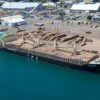
For the NZ log trade, Lanshan Port is the most significant as the largest destination for NZ logs. Lanshan is on the southern border of the Shangdong province. It is a central hub of many sawmills and as your average Boeing 737 flies, is about 480km north of Shanghai.
The softwood log consumption across the Eastern Seaboard as at early May had slipped under 60,000 m3 per day but is better than expected for the time of year.
Lanshan port is running at 27,000 m3 per day usage. Not all usage is NZ Radiata pine but still 35-40% of our total normal supply on an ongoing basis. Just to put this into context, 27,000 m3 is nearly 75% of the volume on a Handy Class logger vessel, of which there are more than 50 carrying NZ logs to China on a monthly basis.
The reason Lanshan is highlighted in this report is because it is a key market driver for NZ logs with log price settlements across the Eastern Seaboard reflecting what is happening in Lanshan.
Importantly, at mid-May, in the Shangdong and adjacent Jiangsu provinces bordering Lanshan, the log trader breakeven level being the difference between the wholesale prices traders get for NZ logs and what they pay kiwi exporters, has widened to about a US$7 per m3 shortfall.
I doubt you will need an abacus to work out what could lay around the corner if prices in China do not lift to cover the breakeven margin and very quickly. Gently put, there is potential for supply demand forces 101 to not end well for NZ logs in June.
The counter to what could be a negative, is the current slow-down in harvest volumes in NZ. Last month I suggested a 7 to 10% drop but that is now looking to be too conservative. The previously reported impact of increased diesel prices on harvest operations more than 100km from ports, is being doubled down by a drop in volumes from the Nelson region wind damage recovery.
Some harvest of sawlogs is having to be stopped because bugs and pathogens are also really enjoying a chew down on our wonderful radiata pine lying on the ground with phytosanitary constraints now interceding on what can and cannot go to the port.
On a national basis, harvest volumes are looking to be down 20 – 25%. Whilst this is healthy for holding on to export prices, domestic sawmills could run short in some regions. As reported in recent months, domestic sawmills are experiencing a lift in sales, albeit not to levels that would excite their bank managers at this stage.
In India, market prices have been stable but shipping rates are if anything firming as charterers have to pay a premium to get a fixture. Current shipping rates are US$70 – 71 per cubic metre compared to US$42 – 43 for a China voyage.
There is a growing expectation the Free Trade Agreement with India is going to ensure a much better bottom line for Kiwi forest growers with the pre FTA tariff about US$6 – 7 per m3. We can only hope Kiwi exporters do not beat each other over the head with additional volumes which would flood the market and quickly erode the gain.
As always, please remember the thoroughly important message. “It remains fundamentally important, the only way forward for climate, country and the planet, is to get out there and plant more trees”!
Allan Laurie, MNZIF
Laurie Forestry Ltd